


Compiled from reports in Aallarabnews, CBN, Times of Israel and The Christian Post
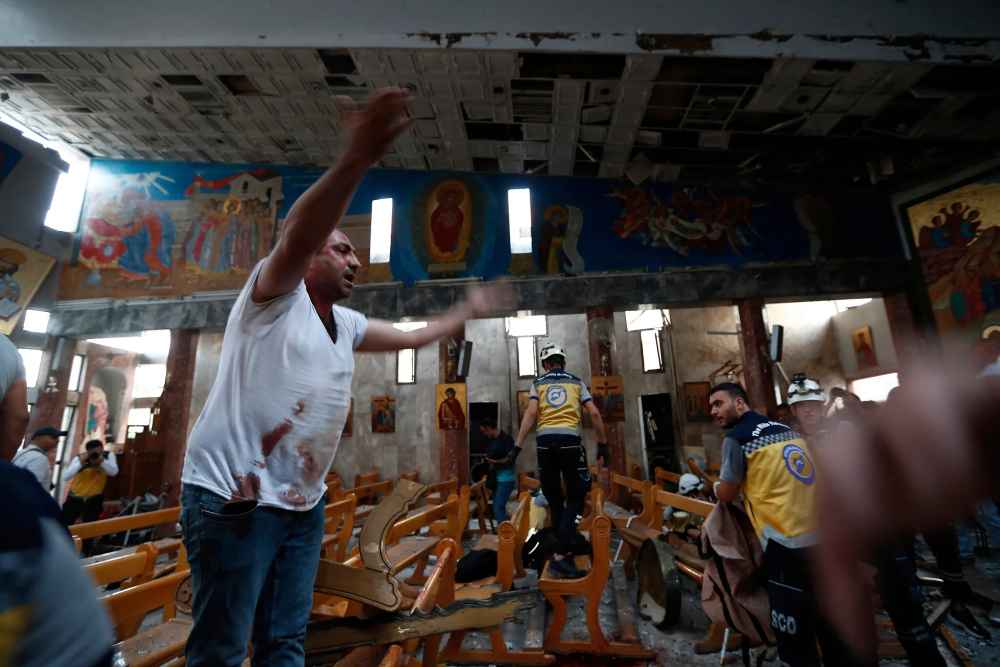
At least 25 people were killed and more than 60 people were injured after a suicide bomber opened fire and then detonated an explosive vest during a prayer meeting in the Mar Elias Church church in Damascus, Syria, at around 5pm on Sunday.
At approximately the same time, attacks took place at other churches across Syria, in what were the first terrorist attacks on churches in the country since rebel forces overthrew Bashar al-Assad in December, ending his family’s decades-long dictatorial rule of Syria.
Since taking office in Janurary, Syria’s interim president Ahmed al-Sharaa has repeatedly promised to protect religious and ethnic minorities. However, the country’s leaders say that terror group Islamic State (ISIS), which once imposed its brutal rule on almost eight million people in 88 000 sq km of land stretching from western Syria to eastern Iraq, wants to destabilise the region during its crucial transitional phase.
According to the Syrian Interior Ministry, the man who attacked the Greek Orthodox, Mar Elias Church during a service attended by about 350 people, was affiliated with ISIS. But no group has officially claimed responsibility.
In the other church attacks in Syria on Sunday, a suicide bomber targeted the Deir Ibrahim al-Khalil Monastery in Douweila, Damascus; terrorist attacked a church in Maqsura called the Church of Our Lady, placing explosive devices at the door. In the cities of Homs and Hama, several churches were attacked by shooters and leaflets were posted on the doors of these churches, reading: “Your turn is coming.”
Syrian Information Minister Hamza Mostafa condemned the deadly Mar Elias Church attack, saying on X: “This cowardly act goes against the civic values that brings us together. We will not back down from our commitment to equal citizenship … and we also affirm the state’s pledge to exert all its efforts to combat criminal organizations and to protect society from all attacks threatening its safety.”
The United States, the European Union and governments across the Middle East condemned the attack, decrying it as a terrorist attack.
“These terrible acts of cowardice have no place in the new tapestry of integrated tolerance and inclusion that Syrians are weaving,” said US Special Envoy for Syria and Ambassador to Turkey Tom Barrack in a post on X. “We continue to support the Syrian government as it fights against those who are seeking to create instability and fear in their country and the broader region.”
Saudi Arabia’s Foreign Ministry, in a statement, affirmed Riyadh’s rejection of “the targeting of places of worship, the intimidation of innocent civilians, and the innocent bloodshed.”
The Greek Foreign Ministry not only condemned the attack but called on the government to do more to protect its citizens. “We demand that the Syrian transitional authorities take immediate action to hold those involved accountable and implement measures to guarantee the safety of Christian communities and all religious groups, allowing them to live without fear,” the ministry said in a statement.
Lawrence Maamari, an eye witness to the Mar Elias Church attack, told news agency AFP that “someone entered (the church) from outside carrying a weapon” and began shooting.
People “tried to stop him before he blew himself up,” he said.
Another witness standing outside the church told the outlet he heard gunfire and then an explosion.
“We saw fire in the church and the remains of wooden benches thrown all the way to the entrance,” he said.
A security source, speaking on condition of anonymity to Reuters, said two men were involved in the attack.
Syrians decried the attack, many seeing it as a blow to stability in the country after 14 years of war. Syrian Christians have appealed that the attack is not just a threat against them, but to everyone in the country, regardless of their religious affiliation.
“It is definitely an attack on civil peace and coexistence in this country,” said Wassim Boutros, who lives in Damascus.
Wajiha umm Mohammed said that she and her daughter were devastated to learn that one of their friends was killed in the attack.
“All our lives, we’ve been Christians and Muslims together — living side by side,” Wajiha umm Mohammed, a Muslim, said. “We’ve never let anything divide us, and we won’t start now.”
She called for more government action to protect minorities.
“On our holiday — Eid al-Adha — there was a strong security presence at the mosque. So during mass, there should also be security, with checks on who goes in and out and proper screening,” she said. “Where was the security for this? This isn’t right — it’s wrong.”
The bombed church held a vigil to pray for the victims of the attack.
“We Christians love the enemy before the ally. We forgive and we love,” said one lady at the church, struggling to hold back her tears. “Why do they harm us? Is it because we are a religion of love?”
Father Semaan Ayoub, one of many clergymen from around Damascus who attended, said the attack was not “humane, religious, or moral.”
“We’ve heard of such attacks, but now we have felt the pain of it, unfortunately,” Ayoub told AP after the vigil. “We are peaceful people. We won’t respond to evil with evil.”
Please help us to keep on publishing news that brings Hope in Jesus:
>> Donate >> Become a Super Subscriber
VISIT OUR YOUTUBE CHANNEL: https://www.youtube.com/gatewaynews100
COMMENTING GUIDELINES
You are welcome to engage with our articles by making comments [in the Comments area below] that add value to a topic or to engage in thoughtful, constructive discussion with fellow readers. Comments that contain vulgar language will be removed. Hostile, demeaning, disrespectful, propagandistic and off-topic comments may also be moved. This is a Christian website and if you wish to vent against Christian beliefs you have probably come to the wrong place and your comments may be removed. Ongoing debates and repetitiveness will not be tolerated. You will also disqualify yourself from commenting if you engage in trolling.