


Originally published in The Christian Post
For six and a half years, Jeff Woodke, a missionary worker with Youth with a Mission Relief and Development, slept outside in the West African desert, often with chains around his ankles.
There was no room, no bed and, for much of that time, almost no human companionship. Temperatures could climb to 120 degrees, and when the rainy season came, he slept on the ground as inches of rain fell around him. His meals rarely changed: rice or a doughlike staple with red sauce and, occasionally, dried goat meat.
For two months, his captors confined him during the day inside a box roughly 1.2m wide, 1.2m long and 1.2mhigh and would not speak to him.
“They would not even speak with me just to try and break me,” Woodke told The Christian Post. “There was a psychological dissociation, complete dissociation. I basically went nuts for a while. Lost time. Lost a lot.”
It was one of the darkest periods of a captivity that began on October 14 2016, when armed militants stormed Woodke’s home in Abalak, Niger, and kidnapped the longtime missionary worker. He would not be free again until March 2023, when he went home to his wife and grown children and two grandchildren.
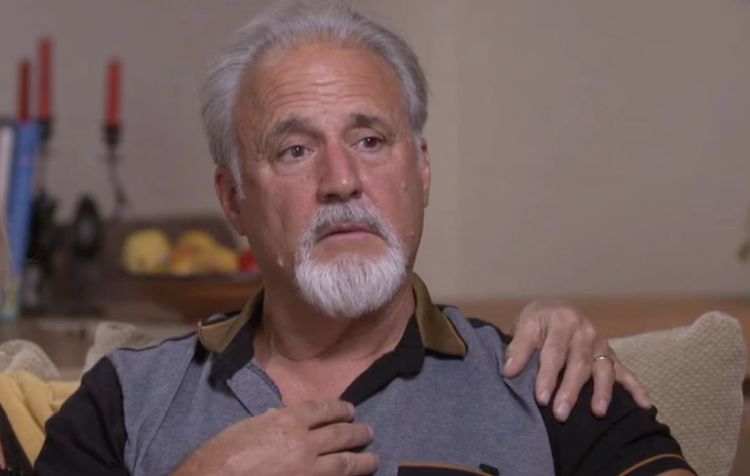
“I was trafficked,” the McKinlyville, California, native said. “That’s what I was. I was kidnapped, and I was sold, and I was the property of another human being, or at least they thought I was.”
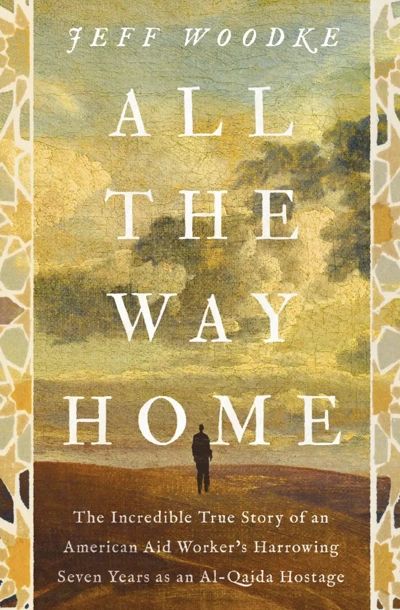
Now, Woodke is recounting his kidnapping, years of captivity and difficult return home in All the Way Home: The Incredible True Story of an American Aid Worker’s Harrowing Seven Years as an Al-Qaida Hostage.
The memoir is not, Woodke told CP, a neatly-wrapped story about praying for a miracle and receiving one. It is about what remains of faith after almost everything else has been taken away and God’s ability to carry His children through unimaginable suffering.
Woodke, married to his wife, Els, had spent decades working among vulnerable communities in Niger and was about a year away from retirement when gunmen arrived that October night.
He shared with CP how he stepped outside to speak with the guards before bringing out his bed to sleep in the cooler night air. One of the guards noticed a suspicious vehicle and reached for his rifle when Woodke saw the muzzle of a gun in his peripheral vision.
“There was a muzzle flash,” he recalled.
Gunfire erupted, and Woodke dropped to the ground as people around him were shot. Believing he could be killed at any moment, he ran, but his escape lasted mere moments. The attackers chased him, beating him with rifle butts as he fled. Woodke’s robe came off as he ran into a nearby courtyard. A blow from a rifle butt severed his Achilles tendon and sent him to the ground.
“They just beat the stuffing out of me and drugged me, threw me in their vehicle,” he said, adding that to this day, he has indentations in his skull from the beating that followed. His captors then stripped him naked and drove into the desert.
Woodke recalled praying for God to intervene, and when that did not happen, he prayed for French helicopters to arrive, even if it meant he would die in an attack rather than spend years as a hostage.
“Rather than be a hostage, I’d get blown up because that would be easier on my family and easier on me,” he said. “And that didn’t happen either. And that was the start of six and a half years in captivity.”
Woodke was eventually held by different brigades operating under JNIM, an al-Qaida-linked coalition active in West Africa. Treatment varied depending on which group controlled him, he said. The militants who initially kidnapped him were particularly cruel, he said, and he spent roughly four months with them before being transferred to another al-Qaida group.
A bleak routine
Daily life soon settled into a bleak routine; he’d wait, each morning, for someone to unlock the chains around his ankles so he could use the bathroom without hobbling. He ate essentially the same food for six and a half years, and the sleep conditions were horrific.
“I slept outside on the ground until the very end,” Woodke said. “And it rains in the rainy season a lot, and you just sleep outside on the ground in the rain. It rains hard, like inches in a night … I was always kept alone. I was always in solitary.”
During his two months in the small box, Woodke could not even stand upright. Desperate to preserve some physical strength, he dug into the sand beneath him until he had created a depression deep enough to stand without hitting the roof.
“I made space to where I could run in place,” he said. “That was the only exercise I could get, just to kind of jog in place there.”
The trauma Woodke endured wasn’t just physical; he shared how, as the months went on and the isolation grew, the confinement brought suicidal thoughts. His injured leg was crippled, though he eventually regained enough strength to walk. When some of his captors realised inactivity could kill him, they permitted him to exercise, and Woodke began walking kilometer after kilometer in tiny circles.
Eventually, however, he became so weak that he could no longer walk, and by then, another struggle had overtaken him: his anger at God.
“I don’t think anybody who’s honest is going to go into something like that and go through something like that and have prayers unanswered so long and not have a conflict with God,” Woodke said. “I was very angry with God.”
Woodke had devoted decades of his life to Christian missionary and humanitarian work, and now he was chained in the desert, his prayers apparently unanswered. He questioned what he believed and why God had allowed him to remain captive, and toward the end, when his physical health collapsed, he began a hunger strike.
“I kind of lost my religion, but I gained my faith,” he shared. “I said, ‘God, you know, I’m never going to go home. Why don’t You just kill me? You can kill me.’ So I prayed every day that God would just kill me and I could go home and be with Him in peace.”
When that prayer went unanswered, too, his anger intensified, and at one point, Woodke decided he would stop praying.
“Why am I bothering?” he recalled thinking. “There’s like a million, two million prayers up there. You can just pick any one of them and answer them. They’re all the same.”
Early in captivity, Woodke said, he could spend as many as eight hours a day praying. By the end, he could muster perhaps 20 minutes. Yet he discovered he could not give up those 20 minutes.
“I couldn’t stop praying those 20 minutes for my family because I love my family,” he said.
‘God didn’t take me hostage’
Woodke also continued trying to forgive his captors, something he believes now kept hatred from consuming him. Eventually, his anger at God itself became evidence that his faith had survived.
“If I’m angry at God, there must be somebody there for me to be angry at,” he said. “I must have some sort of faith that I cannot get rid of. It won’t go because I tried.”
“I never felt God’s love, like for me, the warm fuzzies or anything like that,” he added. “But I felt it for other people. I felt it going through me and out of me. And I realised, well, that is the core of our faith. There’s nothing really greater than that.”
“God didn’t take me hostage,” Woodke continued. “He didn’t want me to be hostage. He didn’t keep me in chains. He didn’t beat me. He didn’t cripple me. He didn’t hurt me. Didn’t hurt my family. People did those things. They were all choices that people made, for good or for evil.”
“What God did was something far greater. God got me through it all, and that’s my faith right there.”
By the time freedom finally arrived in March 2023, Woodke had been a hostage for so long that he could no longer imagine another existence. He’d learned about Covid-19 but received so little information that he came to believe his family might have died during the pandemic.
“I could not imagine freedom,” he said. “This is hard for you to understand, but I could not imagine freedom.”
“I thought my family was dead because of Covid,” he said. “I kept praying, but I really believed they were dead. Anytime I thought about getting out — and that’s what I called it, out. There’s in and there’s out — it would just fall apart in my mind.”
He had also become convinced he was too damaged to return to his family.
“What are you going to do?” he remembered thinking. “How do you come back from this? How is it possible?”
Coming home
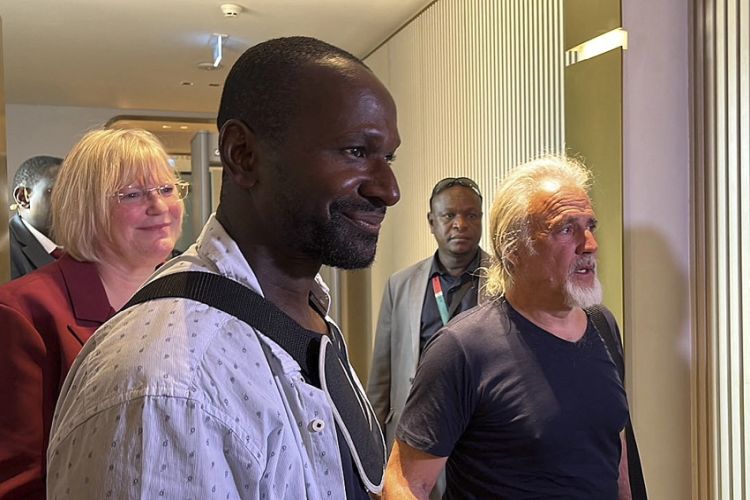
He did come back; The White House only stated that “the United States did not pay ransom or make any other concessions” and that Woodke’s release was a “collaborative effort.”However, release was not the end of his ordeal.
“Coming home was a huge challenge, and it was a challenge for my family,” Woodke said. “It was a challenge for me. It still is a challenge for me.”
He had to figure out, he said, “what it meant to be a human being again, rather than an animal. …. [the coping mechanisms learned in captivity] don’t just turn off,” he said. “It’s not a switch in your brain.”
Woodke continues to contend with PTSD and the effects of prolonged captivity, including physical ailments, but credits his faith, therapy and his family with helping him rebuild his life.
“I have a really good therapist and a great family,” he said.
Woodke’s captivity has also given him an unusually personal vantage point on the rise of extremist groups across the Sahel region of Africa in recent years. The missionary said that poverty, neglect, lack of education, foreign influence and religious radicalisation have combined to create conditions in which extremist groups can recruit.
For an impoverished young man with few prospects, he said, militants can offer a motorcycle, rifle, phone, money and status.
“Boom! They’ve got hundreds and thousands of people that want to sign up to that,” he said. “That has totally destroyed a good chunk of West Africa for generations to come. … I don’t think that the solution is military. I think the solution is humanitarian and love and grace and nonviolence.”
But Woodke is equally clear that this is not the moment for Western missionaries to recklessly enter the most dangerous regions. Instead, Western Christians should support local missions and humanitarian organisations already serving their communities.
“Not right now,” he said. “If they go in there right now, they’re just going to get taken hostage again. … It doesn’t have to just be American, North American or Western missionaries going and doing this.”
“We don’t own the Gospel, or we don’t have a corner on the empathy market either. We can train up, support and equip and build the capacity of local organisations to do the job.”
‘The focal point of our faith’
When Woodke was finally released six and a half years after being kidnapped, he was ordered to strip naked again, something he told CP gave him a way of understanding his captivity.
“I went in naked. I carried nothing except what was within me,” he said, adding that despite the external humiliation, what was within him was something his captors could not reach.
“What was within me was eternity in my heart, just like it says in Ecclesiastes,” Woodke said. “And that expanded to fill the space where everything else got ruined and destroyed.”
“I believe that the greatest revelation of God that mankind will ever have is the life, death and resurrection of Jesus Christ,” Woodke said. “That should be the focal point of our faith, and that should be the lens through which we look at all Scripture and at our world and at each other.”
After seeing “the worst and the best” of humanity, Woodke said he’s convinced that darkness cannot ultimately be defeated by another form of hatred.
“The only way we’re going to conquer it is not through politics and rhetoric and dogma and exclusion, but through love,” Woodke said. “And that means laying down your life for your neighbour, and that is how we suffer for Christ.”
All the Way Home: The Incredible True Story of an American Aid Worker’s Harrowing Seven Years as an Al-Qaida Hostage is now available.
Please help us to keep on publishing news that brings Hope in Jesus:
>> Donate >> Become a Super Subscriber
VISIT OUR YOUTUBE CHANNEL: https://www.youtube.com/gatewaynews100
COMMENTING GUIDELINES
You are welcome to engage with our articles by making comments [in the Comments area below] that add value to a topic or to engage in thoughtful, constructive discussion with fellow readers. Comments that contain vulgar language will be removed. Hostile, demeaning, disrespectful, propagandistic and off-topic comments may also be moved. This is a Christian website and if you wish to vent against Christian beliefs you have probably come to the wrong place and your comments may be removed. Ongoing debates and repetitiveness will not be tolerated. You will also disqualify yourself from commenting if you engage in trolling.