


Originally published in Christian Daily
Church leaders have warned that growing anti-migrant sentiment in South Africa reflects deeper failures in governance, service delivery and economic inequality, urging authorities and communities to address the root causes of public frustration rather than scapegoating foreign nationals.
In a webinar convened by the Association of Evangelicals in Africa (AEA) on June 10, church leaders, refugee representatives and human rights advocates discussed the growing tensions and their impact on communities across South Africa.
Participants argued that while unemployment, crime and deteriorating public services remain legitimate concerns for many South Africans, migrants are increasingly being blamed for problems rooted in deeper structural challenges.
“We are here first and foremost to learn what exactly is happening in order that we may be able to define what the problem is,” Dr. Master Matlhaope, the General Secretary of the Association of Evangelicals in Africa (AEA), said.
Matlhaope explained that the goal was not to assign blame, but to understand the crisis and identify solutions that could contribute to what he described as a peaceful and prosperous Africa.
The church intervention represents one of the most coordinated faith-based responses to the migrant crisis since tensions escalated in several South African communities in recent months.
Refugee representatives participating in the discussion described what they said were worsening conditions in parts of KwaZulu-Natal and other provinces.
Mnindje Kabakiiwa, from the South Africa Refugee Led Network (SARLN) said refugee-led organizations had spent days visiting affected communities, including Durban and other towns where migrants reported intimidation and restrictions on their businesses.
“People are terribly intimidated daily. Children of refugees, the majority of our kids in some particular areas, can no longer even go to school,” Kabakiiwa said.
He said refugee-owned businesses had been forced to close in some communities, leaving families struggling to survive.
“This situation has put a lot of refugees and asylum seekers in a position where they can no longer even afford to pay the rent where they stay,” he said.
According to Kabakiiwa, many refugees now find themselves trapped between community hostility and administrative delays in obtaining documentation through government systems.
“There are a whole bunch of situations which refugees find themselves in and are confused because we don’t know at this particular moment what can be done,” he said.
Impact on children
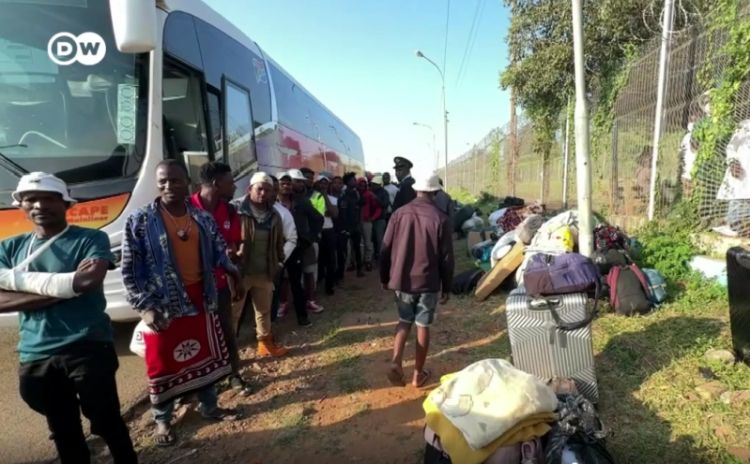
An anti-immigrant protest in the city of East London in March triggered protests and violence against African immigrants in other cities South Africa, prompting several countries to assist citizens seeking to leave the country. Nigeria has organised voluntary repatriation flights for affected nationals, while Ghana has also facilitated the return of hundreds of its citizens amid growing concerns about the safety of migrants.
It is estimated that the number of foreigners living in South Africa is between 2.4 million and 3.1 million, according to official sources.
President Cyril Ramaphosa has condemned xenophobic violence and warned against vigilante actions targeting migrants, saying immigration enforcement remains the responsibility of the state. While acknowledging public concerns about undocumented migration, Ramaphosa said criminal acts against foreign nationals could not be justified and pledged action against groups inciting violence.
Human rights activist Sharon Ekambaram argued that migrants are increasingly being blamed for problems that originate elsewhere.
“There are genuine social and economic grievances that we have as a country, as people,” Ekambaram said during the AEA call. “But what is happening is that migrants are scapegoated for these social and economic problems and challenges that people are facing.”
Ekambaram described what she characterised as a humanitarian crisis affecting migrant communities.
She said organisations working with migrants had documented reports of intimidation, business closures, forced evictions, barriers to health care and disruptions to children’s education.
“What we are seeing is that people are living in constant fear and insecurity, and this has resulted in high levels of trauma,” she said.
She said the effects were particularly severe for children.
“Migrant children have difficulties enrolling in schools, they’re experiencing bullying and discrimination, they’re interrupting education because families are being displaced,” Ekambaram said.
While acknowledging the challenges facing many South Africans, Ekambaram rejected the notion that xenophobia is unavoidable.
Ekambaram linked the tensions to broader governance concerns, including corruption, poor service delivery and widening inequality.
Broader governance issues
She pointed to longstanding problems in local government administration and said public frustration is increasingly being redirected toward vulnerable communities rather than those responsible for policy failures.
“Johannesburg is currently in the spotlight, and there’s many years of reports of qualified audits, of mismanagement, of unaccounted for funds,” she said.
“The real enemy that we need to be dealing with is the ever-growing gap between the rich and the poor,” Ekambaram said.
Church leaders participating in the webinar said congregations have already begun responding to the humanitarian needs created by the unrest.
Mxolisi Nyuswa, the Programs Director at KwaZulu-Natal Christian Council, said churches in KwaZulu-Natal had established emergency support mechanisms to assist displaced migrants.
“The church is not quiet,” Nyuswa said. “When actually the social movements started to stage protests in different towns, we already started to look at the ways in which we can come in (support immigrants).”
He said churches were collecting food, blankets, clothing and other essentials while also organising trauma-healing and counseling sessions.
“There are people who are sleeping in the streets,” he said.
Nyuswa described migrants camping outside government offices and police stations while seeking assistance and protection.
He said church leaders were also working with humanitarian organisations and community groups to organise dialogue sessions between local residents and foreign nationals.
One such initiative planned in Durban would bring together South Africans and migrants to discuss grievances and reduce tensions.
“We are looking forward to having that dialogue,” Nyuswa said.
For the church leaders gathered, the crisis facing migrants is not simply an immigration issue. They agreed that is a reflection of deeper challenges confronting South Africa’s democracy, economy and social fabric.
Please help us to keep on publishing news that brings Hope in Jesus:
>> Donate >> Become a Super Subscriber
VISIT OUR YOUTUBE CHANNEL: https://www.youtube.com/gatewaynews100
COMMENTING GUIDELINES
You are welcome to engage with our articles by making comments [in the Comments area below] that add value to a topic or to engage in thoughtful, constructive discussion with fellow readers. Comments that contain vulgar language will be removed. Hostile, demeaning, disrespectful, propagandistic and off-topic comments may also be moved. This is a Christian website and if you wish to vent against Christian beliefs you have probably come to the wrong place and your comments may be removed. Ongoing debates and repetitiveness will not be tolerated. You will also disqualify yourself from commenting if you engage in trolling.