

By Mike Pothier — programme manager Southern African Catholic Bishops’ Conference Parliamentary Liason Office
1. Introduction
“The performance of power without the substance of vision… The grandeur of office without the humility of service… The spectacle of the state without the quiet, determined work of development.”1
The notion of the deep state has become common in recent decades. It refers to the existence, real or imagined, of an unelected and permanent coterie of state officials, often including members of the security services, who conspire to run a country independently of, and even contrary to, the intentions of the duly elected governing authority. Although elements of the deep state no doubt exist in many places, its myth also functions as a useful excuse for politicians who lose elections or who fail to carry out their policy agendas.
The deep state operates, if at all, primarily for ideological and political reasons. Deep state actors see themselves as a safeguard against the destabilising tendencies of ‘here today, gone tomorrow’ politicians. Its close cognate, the shadow state, on the other hand, sets out to capture public institutions for base economic purposes: to extract money, to win tenders, to steal resources. It had its heyday here in the era of state capture, but it undoubtedly continues to exist, as the current enquiries into police corruption are showing.2 It also shows itself in the many “mafias” that inveigle themselves into public housing and construction projects, and into the provision of water tankers and other functions in which municipal services have collapsed.
Both the deep state and, in South Africa especially, the shadow state are to be taken seriously, but there is a third ‘state’ that is perhaps the most worrying one – the shallow state. This is the state that, for a variety of reasons, cannot or does not carry out its duties. It has been hollowed-out, its capacities diminished and its resources depleted. In many places around the country it can do no more than talk about what needs to be done, without managing actually to do it.
There are abundant indications that the South African state is an increasingly shallow one; certainly not yet a failed state, but one in which numerous elected and appointed officials, including those responsible for some of our most important cities and towns, have not only failed to run them in a remotely sustainable manner, but appear to have no idea about how to arrest the process of decline set off by their own inexperience, incompetence or corruption. In this year of local government elections, their failure may well lead to some significant changes in who occupies council chambers and mayoral suites.
2. OUTsurance and other examples
Among the many ways in which the state’s various incapacities affect us, the daily commute undertaken by millions of people to and from work must be one of the most obvious. In much of the country, bus and train public transport is woefully inadequate, leading to congestion on the roads. When this is combined with a breakdown in traffic infrastructure – non- functioning traffic lights, poorly maintained road markings, ubiquitous potholes – chaos ensues. And that chaos is very seldom successfully dealt with by the responsible local authorities which, for whatever reason, never seem to have enough traffic officers or maintenance staff to do the work.
Into such a scenario, in 2005, stepped the insurance company OUTsurance, which began to supply pointsmen and -women to direct traffic at some of the worst intersections in Johannesburg and Tshwane. This was a clever corporate move, and the company has built a brand around it. It has now expanded to at least two municipalities (Stellenbosch and Paarl) which were not particularly known for their traffic chaos, and the project has gone beyond its original “helping- out” purpose to become one of job-creation and skills-training.3
But note that it started out of necessity, supplying a need that the hollowed-out metropolitan councils of Johannesburg and Tshwane could not meet.
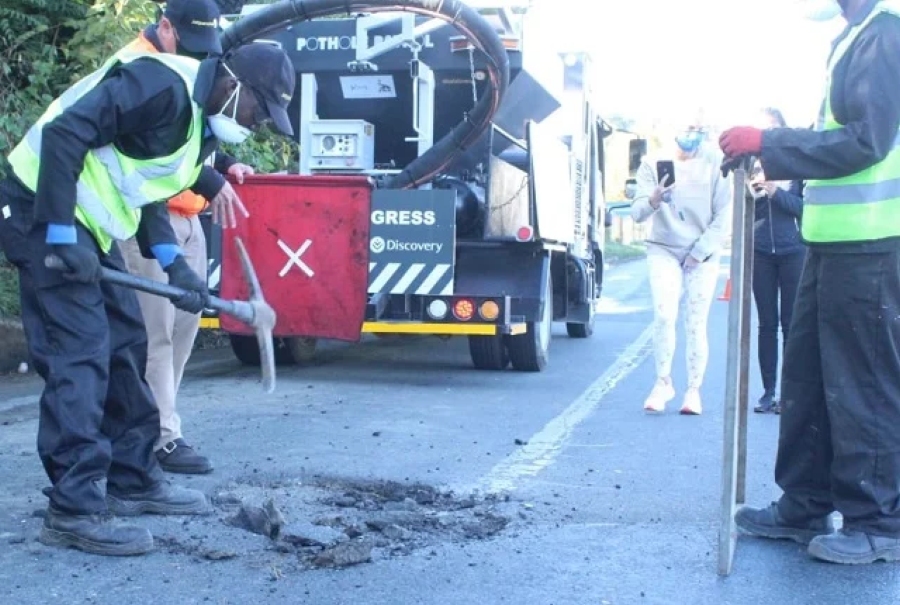
OUTsurance is certainly not the only company to have turned public-sector failure into private- sector opportunity. The financial services group Discovery, supported by the car-hire firm Avis, is now in the business of repairing potholes, and claims to have filled over 300 000 in Johannesburg’s streets.4 Discovery discloses a self-interest in this work, since it calculates that it has saved R44 million in reduced claims for pothole related damage over the period. However, this should not obscure the underlying point – like OUTsurance, Discovery stepped in to remedy a situation brought about by municipal incapacity and to do work which it, and millions of ratepayers, were already paying the public authorities to do.
Alongside the corporates, all over the country ‘ordinary’ citizens are filling in for the shallow state. Still on roads, a group of Free State farmers were busy last year repairing 54 kilometres of road in the Harrismith area.5 Refuse removal, water supply issues, cleaning parks and beaches, all of these are being undertaken by residents in numerous places across the country.6;7 The list of examples is almost endless. Describing the work of an organisation like Gift of the Givers, for instance, would take pages. There will always be a need for such organisations to step in in emergencies and natural disasters, even in the best run societies, but a line has been crossed when, for example, Gift of the Givers finds itself having to drill boreholes to supply water to a major town like Makhanda (Grahamstown) in the Eastern Cape, due to the haplessness of the municipality.8
So far, we have considered the widespread lack of depth in municipal services, but the problem is evident across the board:
- in health, a doctor raises funds so that patients can have operations that ought to be offered at a state hospital;9
- in education, our government school system is “buckling under demand, is under-resourced, and is haemorrhaging credibility”; into the gap steps a philanthropist with a plan to set up non- profit private schools;10
- in the air, Air Traffic and Navigation Services, the government agency responsible for the safety of air traffic, has failed to properly test and renew flight procedures, leading to numerous delays and cancellations;11
- off our shores, the absence of enforcement is leading to over-fishing and the depletion of crucial species;12
- emergency response and personal security are increasingly being taken over by private sector players, due to the unreliability of state providers;13
- air quality goes largely unmonitored in our most populous, and polluted, province.14
As this random listing shows, there is hardly a sector of government which is unaffected by shallowness – by an inability to get the job done with reasonable efficiency, reliability and despatch. This paper is not much concerned with the reasons behind the problem, but a glance at those public bodies which do do their work well is instructive. Chief among them, perhaps, is the SA Revenue Service, which has very successfully renewed itself after being one of the main victims of state capture. The SA Reserve Bank and the Auditor General (an office of over 400 accountants), together with the Electoral Commission, are other examples. In all of them, leadership has been allowed to get on with the job without political interference, without being hamstrung by cadre deployment, and with a greater degree of autonomy than that enjoyed by most other state agencies. For our purposes, however, it is the consequences of the shallow state that matter.
3. The harm done
Obviously, the state’s general shallowness deprives citizens of many of the specific services, benefits and opportunities that they have a Constitutional right to enjoy. People wait years for a house, months for a permit, weeks for water to reappear in their taps, and hours for the police to arrive in an emergency. But there are also some more systemic harmful consequences that flow from it.
- Reinforcing poverty and inequality
When the state fails to provide the goods and services that are its raison d’être those who can afford to buy them privately, do so – hence, for example, our huge private security industry and the growing presence of residential solar electricity systems in prosperous suburbs; the rest of the population, unable to afford private services, simply does without. This creates both vicious and virtuous cycles – property values in wealthy areas with good security and reliable energy rise exponentially, while those in poorer areas stagnate or, in the worst cases, decline. The gap between rich and poor widens, social instability and frustration grows, drivers of crime emerge, and people feel – and are – trapped in poverty.
- An unfit civil service
There are undoubtedly many thousands of hard- working, honest and diligent civil servants in our country, but no one would seriously claim that these characteristics apply to the civil service as a whole. The shallow state does not foster a strong, capable and professional public administration that can steer the ship of governance through times of political turmoil or transition. And if or when a different party takes over the running of a municipality or a province (or the country) it is consequently hamstrung in its efforts to implement new policies.
- Reluctance to pay taxes
Every now and then someone propose a “rates boycott” in response to municipal service failures. Understandably, people don’t see why they should pay for things they don’t receive, especially when they are having to pay private service providers to fill the gap. This surely also affects people’s attitude to tax morality in general; the crucial sense of ‘money well spent’ that allows people willingly to give the State a large portion of their income simply evaporates, and tax dodging comes to be seen as a legitimate option.
- Loss of faith in democracy
If the state fails to deliver the expected benefits people soon begin to distrust the system behind the state. If ‘nothing ever changes’, what is the point of voting or of being active in civic or community affairs? Democracy itself becomes the scapegoat, as some recent research indicates – only 49% of SA citizens in one survey saw democracy as preferable to other forms of government,15 while another survey showed that slightly more were favourable towards military rule than were against it.16 It is important to note that the disillusion is often with the system of democracy, rather than with any given party or ideology; this makes it all the more difficult for other parties or groupings to convince voters that they have something better to offer.
- Obscuring the good things
Despite the long list of our state’s weaknesses, there is in fact also a significant list of achievements. Some of these are material, such as the much-expanded provision of electricity and clean water in the early years after 1994; the social security system; the provision of social housing; and a general decline in rates of absolute poverty.17 Our achievements in other areas are arguably even more important – citizens enjoy full civil and political rights to a degree that is unheard of in most of the rest of the world; we have a functioning independent judiciary and a set of constitutional institutions safeguarding our rights; and we have a strong, free press and an active civil society to alert us to threats to our rights and to help us combat them. But all this, which is the more remarkable given our history of racial division and political oppression, tends to be lost sight of as people battle to survive the day-to-day disappointments caused by the shallow state.
4. Conclusion
The basic causes of the shallow state are not a mystery. Transforming the civil service (or the public administration, as it is called in the Constitution) from its pre-1994 position as an instrument of apartheid ideology to one that would serve the interests of all South Africans was obviously necessary, and it was inevitable that this process would involve some degree of loss of capacity as experienced civil servants were eased, or forced, out and replaced by people more in tune with the new government’s agenda.
The question was never whether or not transformation was needed, but rather whether it could be done in a way that transferred and preserved the necessary skills, abilities and capacities; and in a way that did not replace one politicised civil service with another. Neither of these seems to have been achieved successfully.
Whether this can be remedied depends very much on how the overarching political situation plays out over the next few years. If the present coalition arrangement survives we may expect a gradual lessening – or at least a balancing – of political influence in the appointment of civil servants. There are signs already that competition within the GNU to show strong ministerial performance can provide more of the political will that is necessary to improve the standard of the public administration. The most recent, and drastic, example is the move of the new DA leader to have his predecessor removed from the agriculture portfolio following perceptions of that ministry’s lacklustre performance in the battle against foot and mouth disease.18
There has also been a much-needed legislative intervention in the form of the Public Service Amendment Act, which was signed into law in April. According to one of the prime movers behind the amendments, the New South Institute’s Ivor Chipkin, “for 30 years, we have struggled with a public service in which political authority reached too deeply into administrative life, with damaging consequences for service delivery, accountability, and the integrity of the state. The Public Service Amendment Act changes that. It gives South Africa the legal framework it has needed since 1994.”19
Ultimately, though, it is up to South Africans to ensure that they get the kind of capable, fit-for- purpose state that they need. In a democracy there is no need to accept corruption, incompetence and dysfunction in the halls of government. A shallow state is not an inevitability. To accept it or reject it is a decision that every voter makes when they approach the ballot box.
Mike Pothier programme manager mike@cplo.org.za
1 Prof Njabulo Ndebele on South Africa’s post-1994 leadership: See https://www.news24.com/ opinions/columnists/opinion-an-unmourned-passing-nathi-mthethwa-and-the-death-of-a-public- servants-promise-20251006-0684
2 ‘The Shadow State’ is also the title of a book dealing with the 2021 murder of the whistleblower Babita Deokaran, by investigative journalist Jeff Wicks. https://www.nb.co.za/en/view– book/?id=9780624095859
3 https://www.outsurance.co.za/about-outsurance/about-pointsmen/
4 https://www.news24.com/business/companies/discovery-has-filled-42km-worth-of-potholes-in-joburg-20250911-0865
5 https://stepupsanews.co.za/2025/08/28/mbalula-approves-a-request-by-farmers-to-repair-roads- his-department-is-failing-to-maintain/
6 https://www.dailymaverick.co.za/article/2025-09-04-communities-repair-roads-water-and-power- in-diy-revolution-as-city-of-joburg-falters/
7 https://www.fixlocal.org.za/content/246
8 https://www.makana.gov.za/gift-of-the-givers-deliver-water-in-makhanda/
9 https://www.timeslive.co.za/news/south-africa/2026-05-27-for-me-this-is-a-calling-limpopo- doctor-uses-own-money-to-help-poor-patients-get-surgery/
10 https://www.dailymaverick.co.za/article/2025-08-31-jannie-moutons-r7-2-billion-panacea-could- heal-south-african-education/
11 https://www.dailymaverick.co.za/article/2025-10-22-air-traffic-and-navigation-services-on-the-runway-to-nowhere/?utm_source=Sailthru&utm_medium=email&utm_campaign=business_maverick
12 https://news.mongabay.com/2025/10/south-african-sharks-threatened-by-fisheries-weak-enforcement/
13 https://www.dailymaverick.co.za/article/2026-06-08-as-sas-public-services-falter- emergency-response-industry-faces-a-privatisation-moment/?utm_campaign=Post-2080&utm_ medium=email&utm_source=business-maverick
14 https://www.dailymaverick.co.za/article/2025-10-16-gautengs-air-quality-monitoring-in- crisis-with-most-stations-offline-in-sas-most-polluted-province/?utm_source=Sailthru&utm_ medium=email&utm_campaign=first_thing
15 https://www.afrobarometer.org/publication/ad1170-democracy-on-shaky-ground-in-south-africa- as-dissatisfaction-with-its-functioning-abounds/
16 https://www.afrobarometer.org/articles/minorities-of-south-africans-support-democracy-oppose- military-rule/
17 https://www.statssa.gov.za/?p=19078
18 https://www.dailymaverick.co.za/article/2026-06-17-foot-and-mouth-disease-bungle-costs- steenhuisen-his-cabinet-post/?dm_source=blocks-grid-wide&dm_medium=card-link&dm_ campaign=inform
19 https://nsi.org.za/news/public-service-amendment-act-2025-south-africa/
Please help us to keep on publishing news that brings Hope in Jesus:
>> Donate >> Become a Super Subscriber
VISIT OUR YOUTUBE CHANNEL: https://www.youtube.com/gatewaynews100
COMMENTING GUIDELINES
You are welcome to engage with our articles by making comments [in the Comments area below] that add value to a topic or to engage in thoughtful, constructive discussion with fellow readers. Comments that contain vulgar language will be removed. Hostile, demeaning, disrespectful, propagandistic and off-topic comments may also be moved. This is a Christian website and if you wish to vent against Christian beliefs you have probably come to the wrong place and your comments may be removed. Ongoing debates and repetitiveness will not be tolerated. You will also disqualify yourself from commenting if you engage in trolling.