

Originally published in Juicy Ecumenism
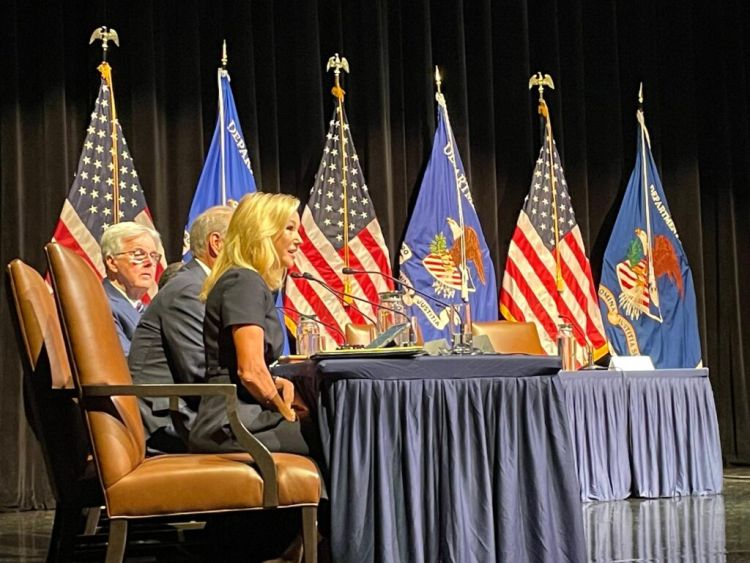
The newly-established Religious Liberty Commission, formed by US President Donald Trump to advise him on matters of faith, conscience, and law, held its first hearing on June 16 in Washington DC This public hearing convened a diverse group of faith leaders, legal scholars, and cultural figures to explore the realities of religious freedom in American life.
Composed of 13 members, the commission draws from Catholic, Protestant, and Jewish traditions. While the commission’s makeup caused understandable skepticism, the committee in the opening session tried to establish a framework for religious liberty that transcended denominational lines and was grounded in constitutional principle. The meeting opened with a prayer from Roman Catholic Bishop of Winona–Rochester Robert Barron and continued with testimony from scholars and public intellectuals.

- Advertisement -
The commission is chaired by Texas Lieutenant Governor Dan Patrick, with Dr. Ben Carson, the pediatric neurosurgeon and former HUD Secretary, serving as vice chair. Other members include:
- Pastor Paula White, founder of Paula White Ministries and key faith advisor to President Trump
- Dr Phil McGraw, psychologist and television host
- Carrie Prejean Boller, former Miss California and author writing on her experience as a conservative Christian woman
- Rabbi Meir Soloveichik, rabbi of Shearith Israel (the oldest Jewish Congregation in the United States)
- Ryan T Anderson, American conservative commentator and President of the Ethics and Public Policy Center
- Kelly Shackelford, constitutional scholar and President of First Liberty Institute
- Allyson Ho, constitutional appellate lawyer
Cardinal Timothy Dolan, Pastor Franklin Graham, and author Eric Metaxas were not present at the first meeting but remain active commission members.
The commission’s stated role is to advise the President on policies related to religious liberty and provide insight into current challenges facing believers in America. Members and witnesses stressed that this mission does not promote any single religious doctrine. Rather, its goal is to ensure that all Americans, regardless of faith, can live and exercise their faith according to the dictates of their conscience.
The commission discussed major historical texts, including George Washington’s Letter to the Hebrew Congregation at Newport and James Madison’s Memorial and Remonstrance, as grounding documents for a pluralistic but faith-friendly public order in line with the originalist and foundationalist approach and make-up of the committee. Throughout the hearing, witnesses and the committee emphasised the need to recover what the founders of our nation intended: a nation where religion is celebrated and encouraged, where citizens can exercise their faith freely by the dictates of their conscience without fear of coercion and manipulation, where autonomy of church governance is maintained, where government does not discriminate against religious entities and organisations, where religious exemptions and accommodations are peacefully given, where government encourages, sustains, and participates in a life of faith, and where truth, morality, and virtue are preserved.
Several scholars and legal experts offered formal testimony in both morning and afternoon sessions. The themes that emerged reflected both legal concerns and cultural aspirations.
Opening remarks by Carson emphasised the spiritual roots of morality and national unity. Others, including McGraw and Prejean, echoed this view, asserting that our inalienable rights stem from God, not government, and that religious liberty is a foundational freedom.
The committee members cited Founding Father and second US President John Adams who argued that “Our Constitution was made only for a moral and religious people. It is wholly inadequate to the government of any other”. They also cited Founding Father and fourth US President James Madison who, in the Memorial and Remonstrance writes: “Before any man can be considered as a member of Civil Society, he must be considered as a subject of the Governor of the Universe.”
The America we see today is a less faith-filled nation with an understanding of truth and morality to be whatever each man sees fit for their own life. Many Americans have become subjects unto themselves. Barron described this modern America as suffering under a “culture of self-invention” and urged a return to objective moral truths in the public square.
Mark Rienzi, president of the Becket Fund and law professor, spoke of the sacredness of conscience and the dangers of government interference. He cited Justice Robert H. Jackson in West Virginia v. Barnette: “If there is any fixed star in our constitutional constellation, it is that no official, high or petty, can prescribe what shall be orthodox in politics, nationalism, religion, or other matters of opinion or force citizens to confess by word or act their faith therein”
This thread ran through many testimonies, especially from Stephanie Barclay, professor of law at Georgetown Law School, Josh Blackman, associate professor at the South Texas College of Law, and Kristen Waggoner, CEO, president, and chief counsel of Alliance Defending Freedom, who argued that the government should almost never burden religious exercise, even under so-called neutral and generally applicable laws.
These legal experts criticised past court rulings that thwarted religious liberty. The Lemon Test, stemming from Lemon v. Kurtzman, was repeatedly condemned as outdated and incoherent.
They also targeted Employment Division v. Smith, which diminished protections for religious exercise. Barkley and others called for its reversal, urging the court to adopt a reformed strict scrutiny standard that sets a very high bar for the government to interfere with acts of religious exercise.
Ho urged the judiciary to display courage in defending the First Amendment, as vague and unclear precedent has left the lower courts with no good example or foundation to lean on when deciding cases of religious liberty. Gerard Bradley, professor of law emeritus at Notre Dame Law School, furthered this exhortation to the Supreme Court by urging them to “kick in the rotten door”. A renewed, proper understanding of religious liberty is ramming in the door of an old, secularised precedent and the Supreme Court needs to allow it to pass straight through.
Furthermore, many witnesses and commissioners asserted that religion is not merely private but a public good. Bradley, for example, argued that religion “supplies the ground for virtue, and virtue for freedom”. He advocated for protecting religion “for the sake of religion”l not just for its social benefits.
This idea was reinforced by Barbara Elliott, Fellow of the Dominican School of Philosophy and Theology, who noted that faith-based organisations (FBOs) are uniquely effective in rehabilitation and social work precisely because of their unique, spiritual element which ought not be stifled.
While speakers noted recent victories for religious liberty, such as in Kennedy v. Bremerton School District and Catholic charity cases, they also warned of unresolved challenges. Lower courts often misinterpret Supreme Court rulings due to vague or inconsistent precedent. Some cases, like Masterpiece Cakeshop v. Colorado Civil Rights Commission, threw out the case based on religious animus and simply punted resolving the foundational questions till later down the line.
Several witnesses encouraged the Supreme Court to take more religious liberty cases and for lawmakers to ensure that parental rights, institutional autonomy, and religious exemptions are safeguarded.
The hearing concluded with an understanding that America must return to the vision of the Founders, where faith is embraced and liberty is rooted in moral conviction. And as multiple witnesses argued, religious liberty is the bedrock of all our other freedoms: if religious liberty crumbles, so too will all our treasured freedoms.
For Christians, this commission, if it truly fulfills its mission to encourage religious freedom for believers of all faith traditions, is certainly some good news. As Christians, our faith encompasses every part of life and we must have the freedom to exercise this faith publicly, legally, and boldly and to invite members into the body of Christ without fear or a reliance on coercion. As the commission moves forward, it will hopefully advise President Trump to handle religious liberty issues with care, wisdom, and prudence and reinvigorate discussion on the proper role of faith in American democracy.
Please help us to keep on publishing news that brings Hope in Jesus:
>> Donate >> Become a Super Subscriber
VISIT OUR YOUTUBE CHANNEL: https://www.youtube.com/gatewaynews100
COMMENTING GUIDELINES
You are welcome to engage with our articles by making comments [in the Comments area below] that add value to a topic or to engage in thoughtful, constructive discussion with fellow readers. Comments that contain vulgar language will be removed. Hostile, demeaning, disrespectful, propagandistic and off-topic comments may also be moved. This is a Christian website and if you wish to vent against Christian beliefs you have probably come to the wrong place and your comments may be removed. Ongoing debates and repetitiveness will not be tolerated. You will also disqualify yourself from commenting if you engage in trolling.