


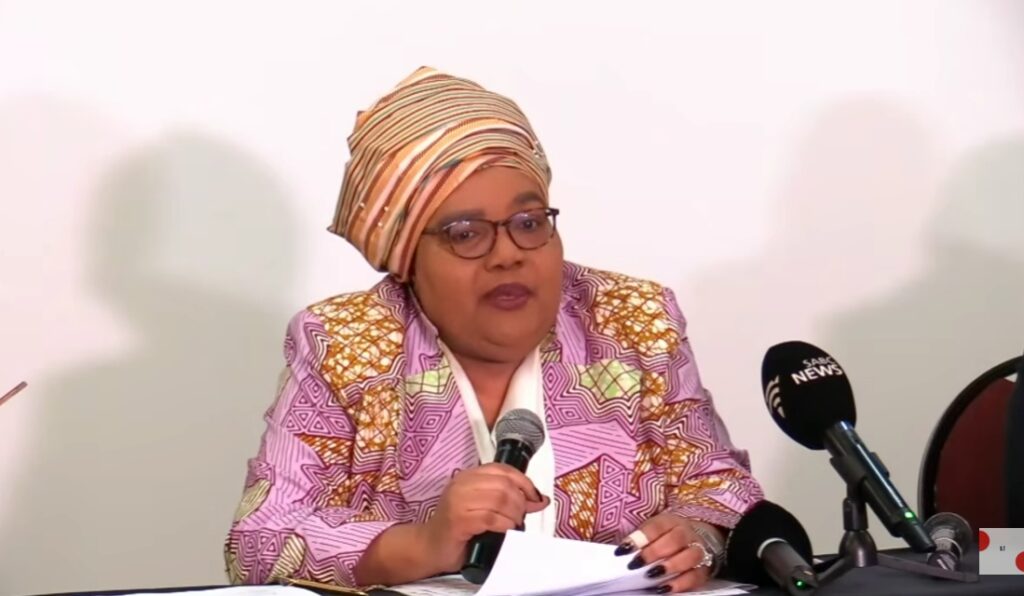
CRL Rights Commission chair Thoko Mkhwanazi-Xaluva stated yesterday that the CRL is not only continuing with the controversial Section 22 process for the Christian community but it is also rolling out Section 22 Committees in other sectors, including African Tradional Religion.
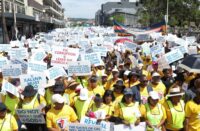
Speaking at a Johannesburg CRL press conference in response to a South African Church Defenders (SACD) mass march for religious freedom on March 12, where calls were made for her to resign and for the disbanding of the Section 22 Committee on abuses in the Christian sector, she said: “ I have absolutely no intention of resigning, of slowing down, of being apologetic about anything. I will stay the course.”
“And the train keeps moving. It’s not gonna stop until the Constitutional Court tells us we are out of order. We’re waiting for that day to happen,” she asserted.
She accused the SACD of “relying on noise and insults and marches” while “I’m relying on prayer.” She also asked whether the SACD’s idea of religious freedom is not “freedom to commit unethical conduct”.
Speaking at the same press conference, Dr John Maloma chair of the Christian sector Section 22 Committee, whose lawfulness is being contested in High Court applications, urged the SA Christian community to engage with the process.
“I stand before you today with a spirit of humility, hope, and a renewed commitment to the sacred task entrusted to us. We are here, not to impose, but to listen. Not to dictate, but to discern. Not to divide, but to unite. Our committee was established under the auspices of the CRL Rights Commission to develop a voluntary self-regulatory framework for the Christian sector – an initiative that I believe is by the Church, for the Church, and with the Church.
‘National conversation’
“The draft framework released for public consultation in December 2025 is not a final document. It is a starting point for a national conversation. And we want to assure the nation that we are doing this in the spirit of the Constitution.
“We acknowledge that some have expressed concern, skepticism, and even opposition to this initiative. To those who have questioned our motives, who fear state overreach, or who believe that the Church must govern itself without external influence, we hear you. We respect your convictions.”
Maloma said all stakeholders would be listened to during a nationwide public consultation process that will conclude with a national summit in Johannesburg in mid 2027.
Freedom of Relgion South Africa (FOR SA) released a press statement today stating that yesterday’s CRL press conference indicates that “it is continuing with a legally contested process that remains constitutionally questionable and substantively unchanged”.
‘Core issues remain unresolved’
“The core issues remain unresolved. The lawfulness of the Section 22 Committee is under challenge before the High Court. Its representation, inclusivity, and procedural integrity are strongly disputed. Despite assurances to the contrary, the CRL’s own documentation shows that there has been no deviation from the stated objective of developing a legislative framework that, irrespective of intent, would fundamentally affect the right to religious freedom.”
FOR SA also notes that during yesterday’s press conference the CRL chair suggested that a legal opinion obtained through Parliament supports the continuation of its process.
“This requires clarification. Whether a process may continue pending litigation is not the same question as whether the process is lawful. That question is currently before the courts in litigation brought by the South African Church Defenders and the Muslim Lawyers Association”, says FOR SA.
Michael Swain executive director of FOR SA comments: “The issue, ultimately, is not whether the CRL can proceed. The issue is whether what it is doing is lawful. If it is not, the process and anything flowing from it are liable to be set aside. The CRL should press pause while the courts consider this matter.”
The FOR SA press statement says that the CRL chair’s vow to press on with the Section 22 process unless directed otherwise by the Constitutional Court, raises serious due process concerns, given the timeframes involved in constitutional litigation.
“When the CRL pushes forward with a process that is under legal challenge, we conclude that they clearly intend to complete this before the courts have ruled,” Swain notes. “There is a real risk that a substantial part, or even the entirety, of the process will be concluded before its lawfulness is determined, potentially undermining the purpose of judicial oversight.”
‘Pre-determined trajectory’
FOR SA also questions assurances that the Final Draft Self-Regulatory Framework for the Christian Sector is merely a starting point for consultation, as the document itself indicates a pre-determined trajectory. “Section 2.3 expressly provides for the development of a legislative framework, including the establishment of a national Christian Sector Practice Council, the registration of religious institutions and leaders, and the implementation of a code of conduct. This is not an open-ended consultation, but one framed around specified regulatory deliverables.”
Swain states, “Meaningful consultation requires that outcomes remain genuinely open.
In this case, the mandate already prescribes a legislative framework, so it is clear that this process is neither neutral nor exploratory.”
FOR SA also challenges the CRL’s description of the proposal as voluntary self-regulation. “However, the elements contemplated, including registration, a ‘Seal of Good Standing’, oversight structures, and compliance mechanisms, are characteristic of regulatory systems. Once linked to legislation, these will effectively amount to state regulation of religious institutions and practitioners, regardless of how they are described.”
Existing laws address abuse
FOR SA’s press statement reiterates its position that SA already has a comprehensive legal framework addressing abuse, fraud, exploitation, and harm to vulnerable persons. “These laws apply equally across all sectors. Religious freedom has never been a defence for criminal conduct. The challenge lies in enforcement, not in the absence of regulation.”
Swain says: “The Constitution requires that the least restrictive means be used when limiting fundamental rights. Where existing laws are sufficient, additional regulation targeting a specific sector, particularly one as constitutionally protected as religion, raises serious constitutional concerns.”
FOR SA also points out that significant and genuinely self-regulatory progress has already been made within the religious sector itself. It notes that following extensive consultation after the 2017 to 2018 parliamentary engagements, a code of conduct for religious practitioners was developed by and for faith communities.
Existing accountability approach
“Grounded in the Religious Freedom Charter, this reflects a voluntary, sector-led approach to accountability. SACOFF, established in 2021, now represents over 24 000 churches and more than 10 million Christians.
“However, these developments have not been meaningfully recognised in the CRL’s current process. SACOFF was excluded from the launch of the Section 22 Committee. Instead, the CRL appears to be advancing a separate framework developed without comparable consultation.”
Swain notes: “The faith sector has already demonstrated its willingness and ability to address accountability through voluntary, community-driven mechanisms. The CRL’s current proposal will effectively replace this with a top-down, state-empowered framework of regulation.”
FOR SA also questions the independence of the Section 22 Committee. “It is established, mandated, and funded by the CRL, operates within a CRL-defined framework, and will report to the CRL before submission to Parliament. “This structure cannot reasonably be regarded as institutionally independent.”
Claims of broad representation are similarly disputed by FOR SA. “Assertions that the process represents ‘over 40 million Christians’ are not supported by facts. The Evangelical Alliance of South Africa has faced significant internal repudiation, and the International Federation of Charismatic Churches has not endorsed the CRL’s approach. The South African Council of Churches (SACC) is not a member of the Section 22 Committee.”
Broad representation disputed
FOR SA also states that significant segments of the faith community, across multiple traditions, have raised objections to both the Section 22 Committee process and its objectives. The expansion of Section 22 Committees to other faith sectors further confirms that this is not a limited initiative, but part of a broader regulatory agenda, says FOR SA. The South African Hindu Maha Sabha and a major Islamic body have already rejected participation.
FOR SA says it remains committed to upholding the constitutional right to freedom of religion, protecting vulnerable persons through existing legal mechanisms, and engaging constructively with stakeholders to strengthen good governance and accountability in the sector. It argues that these objectives are not in conflict and must be pursued within the framework of the rule of law.
FOR SA will says it will continue to monitor the Section 22 process closely, engage government and Parliament, raise legitimate concerns through lawful means, equip the religious sector to understand and defend its constitutional rights, and encourage meaningful public participation throughout the process.
“South Africa does not need new powers to regulate religion. It needs the political will to enforce the laws we already have, and the discipline to respect the constitutional limits on State authority. If those limits are crossed, we will oppose it firmly, lawfully, and without compromise,” concludes Swain.
Please help us to keep on publishing news that brings Hope in Jesus:
>> Donate >> Become a Super Subscriber
VISIT OUR YOUTUBE CHANNEL: https://www.youtube.com/gatewaynews100
COMMENTING GUIDELINES
You are welcome to engage with our articles by making comments [in the Comments area below] that add value to a topic or to engage in thoughtful, constructive discussion with fellow readers. Comments that contain vulgar language will be removed. Hostile, demeaning, disrespectful, propagandistic and off-topic comments may also be moved. This is a Christian website and if you wish to vent against Christian beliefs you have probably come to the wrong place and your comments may be removed. Ongoing debates and repetitiveness will not be tolerated. You will also disqualify yourself from commenting if you engage in trolling.