


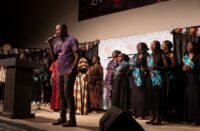


Cape Town author and speaker Amanda Perry (above) shares her testimony of living under the weight of exhaustion and burnout for 23 years — and how she gained recovery
It was the middle of the night, and I was too weak to get myself out of bed. So I put my pillow on the floor and rolled out onto it.
Not because the floor was more comfortable. Because I did not have the strength to stand, and the floor was where I stopped.
By then I could not shower. I could not cook. I could not take my daughters to school. I had moved back in with my parents. And for 23 years I had believed that what I was feeling was a devotion problem.
Nobody stood in a pulpit and told me that. It is not taught. It is implied, and the implication is louder than a sermon: the woman who does the most loves God the most. Tiredness is proof you are pouring out. Rest is what you get to once the serving is finished, and the serving is never finished.
So when the exhaustion came, I did what the implication had trained me to do. I prayed harder. I served more. I went looking for the sin in it. I asked God what was wrong with my faith, because I had absorbed the idea that a weary Christian is a Christian who has drifted.
That question kept me in it for two decades.
Why the diagnosis matters
This is not a semantic point. It is the whole thing.
If you treat a load problem as a sin problem, the treatment you prescribe is repentance, more devotion and more service. Every one of those adds weight. So the cure increases the disease, and because you are doing the spiritually correct thing, you cannot see why you are getting worse. You conclude that you are the problem. Then you try harder.
I watched this happen to me through trauma, businesses I lost, the sudden loss of my husband, and a body that eventually stopped negotiating. It did not arrive one morning. It escalated. First my memory went. Then my words went. Then my health went. Each stage felt like the new normal, because your eyes adjust to the dark. You do not notice the light going. You notice when you cannot see.
What Scripture actually does with exhaustion
Here is what I wish someone had shown me at year five.
Elijah has just come off the greatest public victory of his ministry. Then he runs into the wilderness, sits under a broom tree and asks God to take his life. God does not rebuke him. God does not question his faith. An angel wakes him, gives him food and lets him sleep. Then wakes him and feeds him again, and says: “Get up and eat, for the journey is too much for you.”
Food and sleep. Twice. Before a single word of correction. The conversation on the mountain comes afterwards.
Then there is Moses, judging Israel from morning until evening, and his father-in-law watching him do it. Jethro does not tell him to pray about it. He says: “What you are doing is not good… The work is too heavy for you; you cannot handle it alone.” The problem is named as a load and the solution is structural. Distribute it.
And there is Jesus, who withdrew to lonely places to pray. Luke does not say He did it once. He says He did it often, and He did it with crowds still waiting.
None of these is a story about weak faith. In all three, God treats exhaustion as a matter of the body and the load. Our instinct in the Church is to treat it as a matter of the heart. That instinct is well meant and it is doing damage.
What actually changed
Not a dramatic healing. I want to be honest about that, because I have read enough testimonies that skip the middle.
What changed was one sentence, on that floor, and it was not a correction. It was: “My girl, you were never meant to carry these things.”
That is where the theology broke open for me. Rest is not sleep. Sleep is something the body does. Rest is surrender, and surrender means saying out loud that God is in control and I am not. Which is precisely the sentence striving exists to avoid.
My own particular error is worth naming, because I meet it constantly in other Christian women. I treated my calling like a business. I was striving to make the thing God had given me thrive, instead of resting in the fact that He was the one guiding my steps. Proverbs 16:9 had been on my wall for years. I had never once let it change my diary.
Recovery was slow and unglamorous. I wrote a book through it, and what surprised me was that every page put something down. I had not realised how much I was holding until I started setting it out in sentences.
What I would ask of the Church
Two things, offered gently, from someone who was inside this for a very long time.
To those who lead: when a tired person comes to you, resist asking about their quiet time first. Ask what they are carrying, and ask who else could carry some of it. Jethro is a better model here than Job’s comforters, and a more biblical one.
To those who are tired: your exhaustion is not evidence against your faith. You are not further from God because you are depleted. You may well be closer to Him than you have been in years, because depletion strips out everything you were using to earn what was always a gift.
Jesus says: “Come to me, all you who are weary and burdened, and I will give you rest.”
He does not say come to me and try harder. I spent 23 years hearing it that way. I would like to spare somebody else the second decade.
Please help us to keep on publishing news that brings Hope in Jesus:
>> Donate >> Become a Super Subscriber
VISIT OUR YOUTUBE CHANNEL: https://www.youtube.com/gatewaynews100
COMMENTING GUIDELINES
You are welcome to engage with our articles by making comments [in the Comments area below] that add value to a topic or to engage in thoughtful, constructive discussion with fellow readers. Comments that contain vulgar language will be removed. Hostile, demeaning, disrespectful, propagandistic and off-topic comments may also be moved. This is a Christian website and if you wish to vent against Christian beliefs you have probably come to the wrong place and your comments may be removed. Ongoing debates and repetitiveness will not be tolerated. You will also disqualify yourself from commenting if you engage in trolling.