




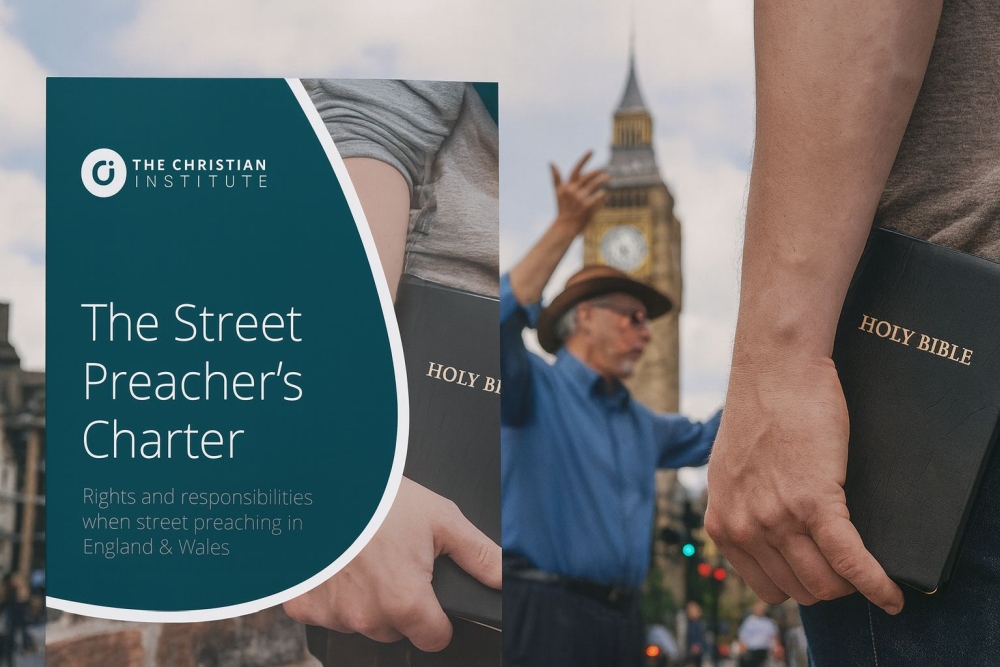
By William Calvienne*
William Calvienne*, a European street preacher with a background in civil-rights law, argues that the UK’s new Street Preacher’s Charter is soft law in the making and restrains Gospel freedom in Britain
*nom de plume
- Advertisement -
Last week, the Street Preacher’s Charter was presented in the UK Parliament. The document was produced by The Christian Institute, a British non-denominational Christian charity that has built its identity on defending Christian freedoms, promoting biblical teaching, and supporting believers in legal challenges relating to religious liberty. The Institute is well known for backing street preachers who were unlawfully arrested, opposing restrictions on religious expression, and arguing for strong protections under Articles 9 and 10 of the European Convention on Human Rights.
It is therefore remarkable that this Charter does not read as a robust defence of Christian freedom. Instead, it introduces a set of behavioural expectations that function more as self-limitation than as protection. The very organisation that normally resists state encroachment now appears to provide a framework that could make such encroachment easier.
A code of conduct disguised as protection
Although presented as a guide to help Christians preach safely and confidently, the Charter’s tone is very different. It spends far more time explaining what preachers should not do: don’t be too loud, don’t be too direct, avoid sensitive topics, avoid sharp critiques of other religions, and keep your message culturally “acceptable”. The emphasis is not on what the law allows, but on how preachers must adjust their behaviour.
The striking thing is that the Christian Institute has not produced a defence of freedom this time, but has in fact delivered a blueprint for self censorship.
Rights overshadowed by restrictions
The Charter briefly mentions freedom of speech and freedom of religion, but these rights are immediately overshadowed by warnings, exceptions and legal risks. The structure is clear: rights are acknowledged, then quickly fenced in by behavioural expectations.
The underlying message is simple: you are free, but only within the boundaries of social comfort.
Soft law: from friendly guidance to de facto regulation
Formally, the Charter is not law. Yet that is precisely why it carries influence. In the UK, documents like this often become informal standards. This is soft law at work: guidelines that shape expectations long before any legislation is written. First it is advice. Then it becomes the norm. Eventually it becomes the basis for enforcement.
The fact that Parliament has given the Charter a public platform only strengthens its authority. Street preaching is no longer presented as a normal exercise of religious liberty, but as an activity requiring special behavioural rules. That represents a cultural and legal shift.
Vague criteria as tools for restriction
The Charter repeatedly uses subjective terms such as “harassment”, “alarm”, “distress” and “antisocial behaviour”. These terms have often been used in the past to justify removing street preachers who did nothing unlawful.
By embedding these vague concepts inside a Christian-authored Charter, the government and police gain a moral argument: even Christian organisations agree that this behaviour is unreasonable. That makes it easier to regulate religious expression without needing new legislation.
A tension with fundamental freedoms
Freedom of speech does not only protect popular or comfortable messages. It explicitly protects expression that is unwelcome, challenging, exclusive or provocative. Freedom of religion protects the right to proclaim one’s faith publicly.
European case law consistently emphasises that freedom of expression includes the right to say things that “offend, shock or disturb”. Otherwise freedom becomes mere conditional tolerance.
The Charter, however, moves in the opposite direction. It encourages preachers to soften their message, avoid confrontation, and prioritise cultural sensitivity. These are not legal requirements. They are behavioural norms that blunt the clarity of the Gospel.
The curious role of The Christian Institute
What makes the Charter most striking is who produced it. For decades, The Christian Institute has warned against state overreach, opposed vague legal terms, defended preachers against wrongful arrest and argued that police often misuse public order legislation.
Now, however, the same organisation introduces a document normalising the very concepts it previously fought against.
Their traditional role (defender, advocate and counterbalance) shifts in this case to something more like behavioural regulator. Instead of shielding preachers from restrictions, the Institute inadvertently offers a framework by which preaching could more easily be policed.
This makes their role both strategically and theologically curious. The institution that once resisted government regulation of religious speech now provides a document that could legitimise it.
Parliamentary legitimacy: a troubling signal
The Charter’s launch in Parliament further amplifies the shift. It grants the document a quasi-official status, reinforcing the idea that street preaching is a potentially problematic activity requiring oversight.
This reframes public evangelism not as a protected right, but as a regulated practice: a move from protection towards control.
Our freedom is rooted in Scripture, not social acceptability
The earliest Christians preached with boldness, clarity and conviction. They did not operate within culturally approved boundaries. Their freedom was a calling, not a courtesy. Biblical proclamation has always had an edge. It confronts, exposes, invites and transforms.
When Christian organisations themselves publish behavioural codes that tame preaching, the danger lies not only in external restriction, but in internal redefinition. Freedom contracts from within.
Conclusion
The Street Preacher’s Charter presents itself as a guide to freedom, yet in reality it functions as an instrument of self-regulation that narrows the space for public proclamation. Wrapped in the language of responsibility, it embodies the dynamics of soft law and prepares the ground for future, firmer controls.
The Gospel cannot be confined by cultural etiquette or behavioural guidelines. The central question for Christians today is this: Do we seek a freedom truly protected by law, or a freedom gradually absorbed into polite restrictions and soft expectations?
In the context of this Charter, the direction of travel has become unmistakably clear.
Please help us to keep on publishing news that brings Hope in Jesus:
>> Donate >> Become a Super Subscriber
VISIT OUR YOUTUBE CHANNEL: https://www.youtube.com/gatewaynews100
COMMENTING GUIDELINES
You are welcome to engage with our articles by making comments [in the Comments area below] that add value to a topic or to engage in thoughtful, constructive discussion with fellow readers. Comments that contain vulgar language will be removed. Hostile, demeaning, disrespectful, propagandistic and off-topic comments may also be moved. This is a Christian website and if you wish to vent against Christian beliefs you have probably come to the wrong place and your comments may be removed. Ongoing debates and repetitiveness will not be tolerated. You will also disqualify yourself from commenting if you engage in trolling.