

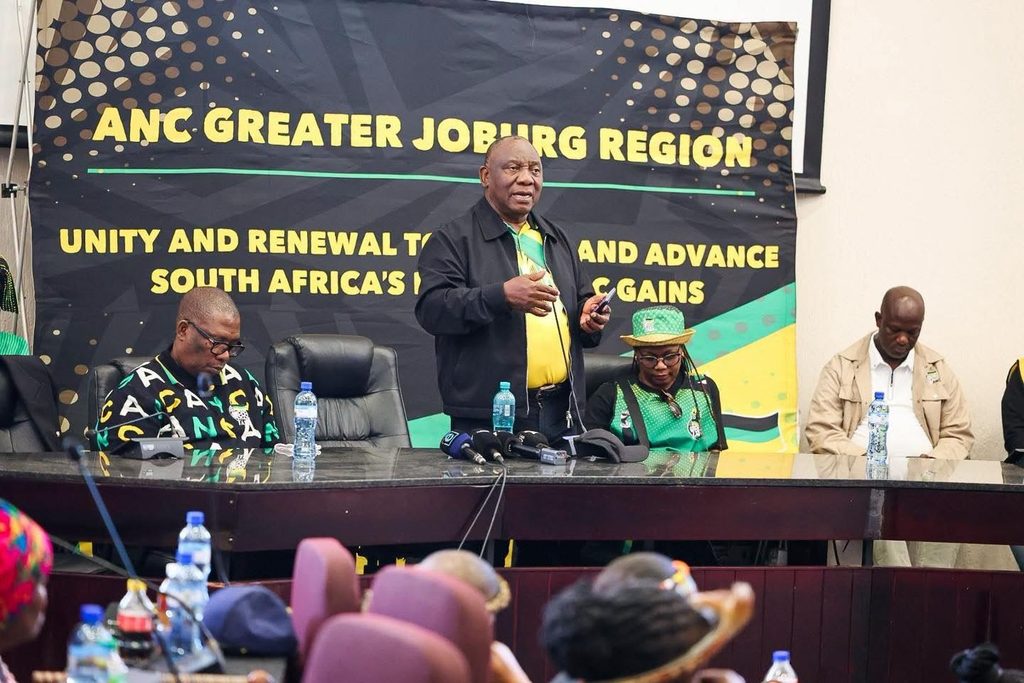
President Ramaphosa has embraced the language of self-regulation for the Church. But a council established by an Act of Parliament to determine where your faith begins and ends is not self- regulation. It is state control by another name. In the article below Pastor Bert Pretorius president of the South African Community of Faith-based Fraternals (SACOFF) explains why the CRL Rights Commission and its Section 22 Committee pose a threat to religious freedom.
This week President Cyril Ramaphosa returned to a hard question: how South Africa should respond to those who abuse people in the name of religion. He signalled a welcome shift. Rather than the state regulating every church, he spoke of self-regulation, with faith communities forming their own bodies, writing their own rules, and holding one another to account, much as lawyers, doctors and accountants do. As a pastor who has spent years building exactly such a body, let me say plainly: on principle, the President is right. The difficulty is that what the CRL Rights Commission is actually proposing, and pushing through its Section 22 Committee, is not self-regulation at all. It is State regulation wearing a borrowed coat.
I write as the founder of the South African Community of Faith-Based Fraternals & Federations (SACOFF), a national umbrella body uniting faith-based fraternals, federations, churches and ministries, with 247 member organisations representing 25 371 churches. We already do what the president describes. South Africa’s faith communities long ago adopted a Charter of Religious Rights and Freedoms and a Code of Conduct; individual churches have constitutions governing membership, discipline and doctrine, often to a higher standard than the law itself (a pastor may be removed from ministry for adultery, which is no crime at all). That is genuine self-regulation: voluntary, owned by the Church, and answerable to the Church.
Parliament has heard this argument before. When the CRL first pressed for statutory oversight, proposing a “peer review mechanism” in its 2017 report, the COGTA parliamentary portfolio committee declined to support it and instead encouraged faith communities to strengthen their voluntary structures and umbrella bodies. That is precisely what has happened. Neither the Code of Conduct the faith sector completed through a consultative inter-faith process in 2019, nor the body I lead, launched in 2021, existed when the CRL made their proposal. Both now exist, and the code has since been placed before Parliament’s portfolio committee, the CRL and its own Section 22 committee. They are hard evidence that the sector has, of its own accord, made real strides in accountability without a State council to compel it. The CRL is not confronting a sector that has failed to reform; it is recycling a proposal Parliament has already rejected, against a sector that has done what Parliament asked.
The different professions the president cites are the key to the confusion. A profession is regulated because it rests on a defined body of learning you must master to practice responsibly. A doctor who misdiagnoses or a lawyer who misreads the law can be objectively shown to be wrong. Faith is not like that. It is, by its 3 nature, personal and varied. That is why the Constitution singles out religion for protection in sections 15 and 31, and why the Constitutional Court, in the Prince case, held that a sincerely held belief enjoys protection even where it may strike others as bizarre, illogical or incapable of scientific proof. What matters is the sincerity of the belief, not whether some panel judges it reasonable or even ethical. You cannot licence orthodoxy the way you licence surgeons.
Consider what a professional council actually is. The Health Professions Council, the Legal Practice Council and the Council for Traditional Health Practitioners are each created by an Act of Parliament, staffed by people appointed and empowered by the state, and answerable to Parliament. It is not a private fraternity but an organ of state exercising public power. The CRL’s own chairperson has been candid about this. In April she said, on the record, that the sector needs an Act “and a council formed out of that Act”, modelled on the Legal Practice Council, with power to strike people off the roll, and that it would fall to that council to say where “your freedom of religion starts here and ends there”. A body established by statute to decide where a citizen’s constitutional right begins and ends is the very definition of State regulation, whatever label is affixed to it.
The proposal also infringes a right the president did not mention. Section 18 of the Constitution guarantees freedom of association, and that right must include the freedom not to associate. That is why every authentic faith community is voluntary. The president reached for the closest true parallel: political parties. They form around their own convictions and run their own affairs, and the IEC holds them to the law. But we do not compel citizens to join an approved party, nor do we pre-qualify people before they may hold a belief or start a political movement. The single test we apply is obedience to the law and the Constitution. Apply that same test to faith, and the case for a licencing council immediately falls away.
Which brings us to the real point. Every abuse the president rightly condemns, such as making people drink petrol, eating snakes, and defrauding and endangering the vulnerable, is already a crime. Assault is a crime, fraud is a crime, and where a child is harmed in a church, there is already a legal duty to report it. The State does not need a new council to act. It needs to enforce the laws it already has, equally, against anyone who breaks them, whether or not they wear a clerical collar. Religious freedom has never been a defence for a crime, and no honest church has ever asked for it to be. The CRL, moreover, already has investigative and referral powers under the Act that created it.
So let us be clear about two distinct things that are in danger of being run together. A church may invite oversight: it may choose to place itself under an umbrella body and submit to its discipline, recording that choice in its own constitution. That is self-regulation, and it is the work of my life. What the CRL and its Section 22 process propose is the reverse: a State-created council of ethics and accountability, compulsory in all but name, empowered to register a church, to grant or withhold a seal of good standing, and finally to deregister it, deciding on behalf of the state where faith may begin and end. Call it whatever you wish, but please do not call it self-regulation. The President is right that the Church should regulate itself. It already does so every day across thousands of congregations. The most valuable thing the state can do for religious freedom now is the one thing only it can do: enforce the criminal law without fear or favour, and trust the Constitution it swore to uphold.
Please help us to keep on publishing news that brings Hope in Jesus:
>> Donate >> Become a Super Subscriber
VISIT OUR YOUTUBE CHANNEL: https://www.youtube.com/gatewaynews100
COMMENTING GUIDELINES
You are welcome to engage with our articles by making comments [in the Comments area below] that add value to a topic or to engage in thoughtful, constructive discussion with fellow readers. Comments that contain vulgar language will be removed. Hostile, demeaning, disrespectful, propagandistic and off-topic comments may also be moved. This is a Christian website and if you wish to vent against Christian beliefs you have probably come to the wrong place and your comments may be removed. Ongoing debates and repetitiveness will not be tolerated. You will also disqualify yourself from commenting if you engage in trolling.