




As a result of my recent trip to Eswatini, I have learned a great deal about this landlocked African nation. Eswatini is the smallest country in Africa, with an area of 17 363 square kilometres. It is one of only a handful of absolute monarchies remaining in the world, with Swazis referring to their country as a ‘monarchal democracy’, an oxymoron if you do not understand the nature of traditional African leadership.
Leadership among the Nguni peoples of southern Africa (including the Zulu, Xhosa, Ndebele and Swazi) is best understood through a framework that brings together relational ethics, hierarchal structures, ritual legitimacy, and conflict resolution. Hierarchical structures can also be referred to as “ascription” – where leadership identity and authority are assigned by birthright rather than earned through merit or elected by popular vote.
As a result of ascription or patrilineal descent, King Mswati III, the country’s ruler, has been in power for 40 years and has unrestricted political authority and a veto over all branches of government and is constitutionally immune from prosecution. The king has multiple wives, and around December and January, he attends the Incwala Kingship Ceremony, a cultural and spiritual event held annually in Eswatini. It is an occasion where the king, accompanied by his subjects, performs rituals to honour ancestors.
Incwala serves the aspect of ritual legitimacy, a key dimension that reinforces and validates the authority of a leader through culturally significant ceremonies and practices. Cultural practices such as Incwala and polygamy, as well as the king’s immunity from prosecution, are things that do not sit well with many Christians. However, you need to see all of this in light of the Church’s mandate to disciple nations (Matthew 28:19). It is easier to fulfil this mission in Eswatini because it declares itself a Christian nation.
In other words, despite challenges related to syncretism and a governance model others may consider to be anachronistic, Eswatini presents greater opportunities for the advancement of the gospel than South Africa. Firstly, Eswatini’s size and its leader’s openness to Christian influence count in the Church’s favour. This now brings me to the purpose of my visit to Eswatini. I was invited by YWAM Mbabane and the Center for Advocacy, Law and Justice to join them in offering training to political, religious and civic leaders on servant leadership.
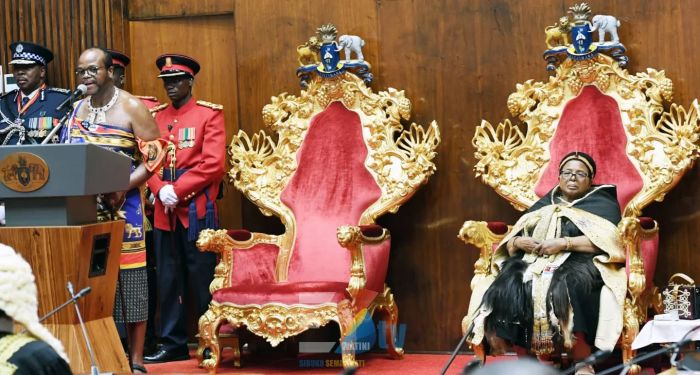
The second thing that brings me hope regarding Eswatini is the aspect of relational ethics. At the heart of Nguni leadership is the ethic of Ubuntu. Ubuntu reflects a communal ontology that positions the leader not as a sovereign individual but as a relational being whose authority is inseparable from the well-being of the community. I saw this ethic play out during Eswatini’s opening of Parliament, which took place the day after we undertook training on servant leadership, that is, February 20 2026.
The occasion was attended by the usual pomp and ceremony and the added spectacle of having the country’s reigning monarch and his mother overseeing proceedings. The Queen Mother is affectionately known as ‘Indlovukazi’ (female elephant). She and the king were ushered into parliament and sat on separate thrones, from where the king gave an opening address that lasted almost two hours. There were times I found myself almost dozing off during the speech, but what kept me awake was that I wanted to take in as much of the experience as possible.
For the most part, the speech laid out the country’s agenda and priorities for the next financial year. As a result, television cameras showed ministers frantically taking notes every time the king said something related to their ministry portfolio. Seeing the king setting goals and targets related to the economy, infrastructure, health, education, etc. was basically observing constitutional monarchy at play.
Thirdly, Eswatini is ripe for the kingdom because of something Swazis themselves believe concerning their nation. Many people I encountered believe that Eswatini’s redemptive purpose is to be the pulpit of Africa. My understanding is that behind any pulpit stand imperfect people. However, if there is one thing we learn from Reformation history, it is that the pulpit can be a place where morals are reformed and nations transformed, something Eswatini, which has one of the world’s highest HIV prevalence rates, desperately needs.
To underscore the idea of Eswatini being a Christian nation and pulpit, in his speech King Mswati declared that the theme for 2026 is “Agape Love”. He went on to lead those in attendance to commit to love their neighbours, something I have never seen a head of state do. Contrast this with South Africa and its commitment to constitutional democracy, where political dissent is likely not to be stifled and where religious, cultural and ideological pluralism is the order of the day.
In comparison to other African countries, South Africa has superior infrastructure, a sophisticated economy, a booming private sector, and a world-class education system. But then again, all of these achievements are undercut by the country’s persistent crime and corruption and the fact that South Africa creates an environment of open hostility towards Christianity. Its much-vaunted constitution empowers bodies like the CRL and the Human Rights Commission to act as guardians over the Church. Then there is also the Hate Speech Act of 2023, a piece of legislation that could possibly criminalise certain theological pronouncements by preachers.
The words of Jesus in Mark 8:36 are fitting for South Africa’s situation. And what do you benefit if you gain the whole world but lose your own soul? South Africa has lost its soul in that it has rejected a Bible-based religious foundation and conservative African values in favour of liberalism and Western norms. Moreover, South Africa exhibits extreme heterogeneity. As a result, we are faced with communication challenges, a higher potential for conflict, slower trust building, and the risk of fragmentation. Whereas a purely homogeneous or single-culture country benefits from a shared identity and norms, a strong sense of belonging, predictability, faster decision-making, and high social cohesion.
Consequently, I encourage you to pray for Eswatini and other Southern African countries. These countries might be smaller and economically largely dependent on South Africa, but culturally and religiously they must not take after us. In fact, we stand to gain a lot from them.
Please help us to keep on publishing news that brings Hope in Jesus:
>> Donate >> Become a Super Subscriber
VISIT OUR YOUTUBE CHANNEL: https://www.youtube.com/gatewaynews100
COMMENTING GUIDELINES
You are welcome to engage with our articles by making comments [in the Comments area below] that add value to a topic or to engage in thoughtful, constructive discussion with fellow readers. Comments that contain vulgar language will be removed. Hostile, demeaning, disrespectful, propagandistic and off-topic comments may also be moved. This is a Christian website and if you wish to vent against Christian beliefs you have probably come to the wrong place and your comments may be removed. Ongoing debates and repetitiveness will not be tolerated. You will also disqualify yourself from commenting if you engage in trolling.