



A broad coalition of civil society organisations in Nelson Mandela Bay has called on President Cyril Ramaphosa to urgently intervene in what it describes as a deepening service delivery crisis in the metro. In a letter addressed to the President, the Nelson Mandela Bay Civil Society Coalition warns that the continued deterioration of electricity, water and sanitation infrastructure is severely harming residents, businesses and the local economy, and may constitute a violation of constitutional rights.
While expressing grave concern about the collapse of essential services, the coalition also emphasises its commitment to being part of the solution. Representing a wide range of organisations — including faith groups, non-profits, business, labour and community structures — the coalition says it stands ready to work with government to restore effective governance, rebuild infrastructure and ensure that the city once again delivers the basic services its residents deserve.
The full letter to the President follows below.
Honourable Cyril Ramaphosa
The Nelson Mandela Bay Civil Society Coalition writes to you with grave concern regarding the accelerating collapse of electricity, water, and sanitation infrastructure in Nelson Mandela Bay. The conditions confronting residents and businesses are no longer merely administrative failures; they constitute a serious violation of the rights guaranteed by the Constitution of the Republic of South Africa.
Our Coalition represents a broad, non-partisan cross-section of society, including non-profit organisations, faith-based institutions, organised business, labour formations, civic structures, youth formations, and community-based organisations. United by shared values, the Coalition exists to promote collaboration, accountability, and ethical leadership in pursuit of the delivery of basic services and sustainable development in the metro.
Our Constitution obliges local government to give priority to the basic needs of the community (s.153(a) of the Constitution). In providing basic services such as water, sanitation, and electricity, it must ensure that each member of the community has access to at least a minimum level of basic service (s.139(5) of the Constitution; s.73(1) of the Municipal Systems Act). These duties have been reinforced in two judgments of the Constitutional Court (Joseph and Mkontwana).
The Constitution of the Republic of South Africa further states in Section 152(1)(e) that a key object of local government is “to encourage the involvement of communities and community organisations in the matters of local government.” This is a direct constitutional mandate requiring municipalities to enable civil society participation. We also refer to the Municipal Systems Act (Act 32 of 2000 and Amendment Act 3 of 2022), which mandates our efforts to participate actively and responsibly.
As the President will appreciate, the Nelson Mandela Bay Civil Society Coalition has declared its commitment to seeing our city function effectively. In this regard, various sectors signed a Social Compact on 28 January 2026, reaffirming our collective readiness to support the rebuilding of the city.
Even so, from this collective vantage point we must state unequivocally: our city is in crisis.
On 6 December 2025, a strategic engagement led by the Minister of Cooperative Governance and Traditional Affairs, Mr Velenkosini Hlabisa, brought together Executive Mayor Babalwa Lobishe, members of the Mayoral Committee, the Speaker, municipal officials, and representatives from national and provincial COGTA. The meeting was convened to clarify the implementation of Section 154 of the Constitution, which obliges national and provincial government to support municipalities in fulfilling their functions.
Regrettably, this intervention has produced no tangible results to date, while the metro continues to regress. As acknowledged during that engagement, the invocation of Section 154 in Nelson Mandela Bay – now for the fourth time – has historically failed to deliver meaningful and sustained improvement.
The deterioration of infrastructure in the metro is not primarily the result of insufficient financial resources. Rather, it is the consequence of political interference in municipal operations, supply chain blockages, and a steady erosion of skills, accountability, and professional management within the municipality.
Since 2023, National Treasury has withheld at least R1.6 billion from the municipality due to irregular and wasteful expenditure and the failure to spend conditional grants appropriately. These funds were intended for critical investments in water, sanitation, and electricity infrastructure.
The consequences are now visible across the metro. Nelson Mandela Bay is facing a severe water management crisis. Dam levels have dropped to approximately 32% usable water, while unaccounted water losses have escalated to 63%, making this the highest water-loss metro in the country. Alarmingly, this places the city’s water security at significant risk.
Electricity infrastructure is equally unstable. The lack of proactive maintenance, combined with inadequate monitoring and protection of municipal infrastructure, has resulted in repeated supply disruptions. Since 2023, at least 202 power outages have been recorded in the metro’s primary industrial and commercial areas, while power dips occur almost daily.
These disruptions have direct economic consequences. Factories are forced to halt production, export and customer orders cannot be fulfilled, and costly scrap and wastage occur. Businesses are compelled to place workers on short time and, as is increasingly the case, workers now face retrenchments.
Infrastructure failures are also affecting the daily lives and dignity of residents. The deterioration of electricity networks, sewerage systems, and other essential infrastructure has created unsafe and unhealthy living conditions, particularly for vulnerable groups including the elderly, the sick, and young children.
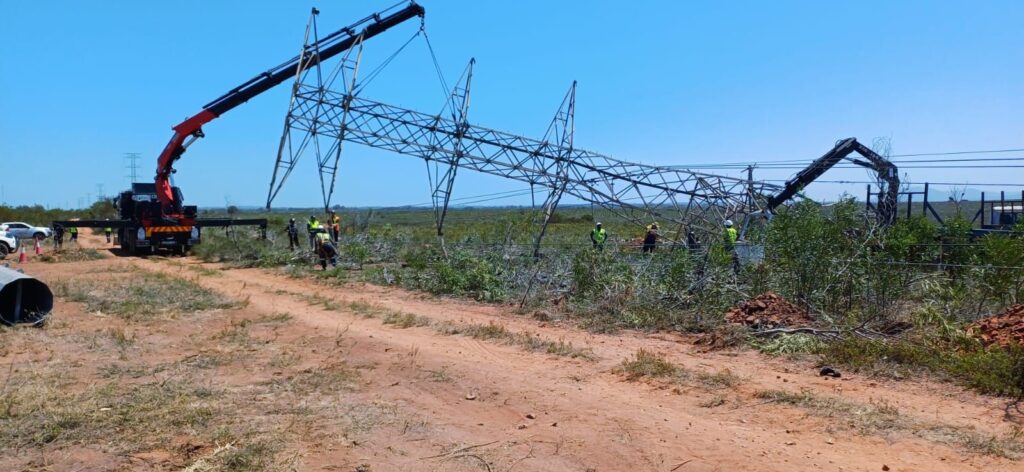
On Wednesday, 11 March 2026, another electricity pylon collapsed, only weeks after a previous failure had been repaired. These incidents are not isolated. They are the predictable outcome of years of neglected maintenance and systemic dysfunction. Each failure leaves communities without power and further undermines economic activity and public confidence.
Concerns repeatedly raised with both local and provincial authorities have not been met with the urgency required.
The contrast between what is possible and what is currently unfolding in Nelson Mandela Bay is stark. When South Africa hosted the G20 Summit in Johannesburg last year, the level of coordination and commitment demonstrated by government structures showed that service delivery challenges and urban decay can be addressed when urgency and accountability are present.
In Nelson Mandela Bay, however, the deterioration has been allowed to continue. Mr President, this is no longer simply a municipal governance matter. It is a constitutional issue that affects the dignity, safety, and livelihoods of hundreds of thousands of residents.
We therefore implore you to take the time on 15 March at 19:00 to view the Carte Blanche documentary, which presents testimonies from residents illustrating the devastating effects of the deteriorating state of infrastructure in Nelson Mandela Bay.
Nelson Mandela Bay is a strategic economic hub for the Eastern Cape and the country as a whole. Allowing its infrastructure to collapse undermines investment, threatens jobs, and places further strain on already vulnerable communities.
The Civil Society Coalition therefore calls on the President to urgently intervene to ensure that decisive and sustained measures are implemented to stabilise governance, restore infrastructure maintenance, and protect the constitutional rights of residents. We believe such intervention should mirror the decisive action taken in Durban’s eThekwini Metro, where the establishment of a focused working group has helped stabilise the situation.
As a further demonstration of our commitment and willingness to resolve our city’s challenges, the Nelson Mandela Bay Civil Society Coalition recently met with the city’s leadership. This engagement took place on 9 February 2026, the same day the President visited the city to pay respects to the bereaved family of Bishop Bolana.
During that meeting, we collectively resolved, among other measures, to establish a joint technical team tasked with working collaboratively to develop an action plan to support the city’s rebuilding efforts.
The people of Nelson Mandela Bay deserve a city that works. They deserve leadership that acts with urgency, competence, and accountability. Above all, they deserve the protection of the rights guaranteed to them by the Constitution.
We urge you to treat this matter with the seriousness it demands.
Yours sincerely
Monga Peter (Chairperson of NMBCSC)
Please help us to keep on publishing news that brings Hope in Jesus:
>> Donate >> Become a Super Subscriber
VISIT OUR YOUTUBE CHANNEL: https://www.youtube.com/gatewaynews100
COMMENTING GUIDELINES
You are welcome to engage with our articles by making comments [in the Comments area below] that add value to a topic or to engage in thoughtful, constructive discussion with fellow readers. Comments that contain vulgar language will be removed. Hostile, demeaning, disrespectful, propagandistic and off-topic comments may also be moved. This is a Christian website and if you wish to vent against Christian beliefs you have probably come to the wrong place and your comments may be removed. Ongoing debates and repetitiveness will not be tolerated. You will also disqualify yourself from commenting if you engage in trolling.